REVIEW · MILAN
Bernina and Glacier Train Two Routes in One Day from Milan
Book on Viator →Operated by Zani Viaggi · Bookable on Viator
This train day packs two Alps into one. I love the Albula Line for its real engineering showpieces and wild mountain views, and I love how the ride makes places like Bergün feel close enough to touch from your window. One catch: the title sounds like two separate express trains, but in practice you’re mainly on a single rail experience on the Albula/Glacier Express first-leg route to St. Moritz.
I also like that you get a professional guide plus an air-conditioned vehicle for the Milan connection, so you are not stuck figuring out timings on your own. The group stays fairly small (up to 50), and your day runs with a mobile ticket and English support.
This is a long day (about 13 hours) and the weather in the Alps can change fast, so you’ll want layers and flexibility if the timing shifts slightly.
In This Review
- Key moments worth planning for
- What this day trip really delivers from Milan
- Milan to the Alps: your guided start matters more than you think
- The UNESCO Albula Line: Chur to the Albula Pass in motion
- Landwasser Viaduct: the engineering moment you’ll actually remember
- Tunnels and viaducts: how the ride keeps you focused
- Bergün and Preda: where the vibe shifts before the descent
- St. Moritz for about 2 hours: what to do with the time
- The return to Milan: why the last leg still matters
- Price and value: what you pay for at $163.53
- Who should book this, and who should skip it
- What to pack for Alps weather that changes fast
- A quick, honest booking decision
- FAQ
- How long is the tour?
- What does the tour include?
- Is food and drinks included?
- What train route will I ride?
- Where do we stop during the day?
- What language support is available?
- Do I get a mobile ticket?
- How big is the group?
- What happens if the weather is bad?
- Is free cancellation available?
Key moments worth planning for
- UNESCO Albula Line route: you ride a World Heritage railway with big climbs and big views
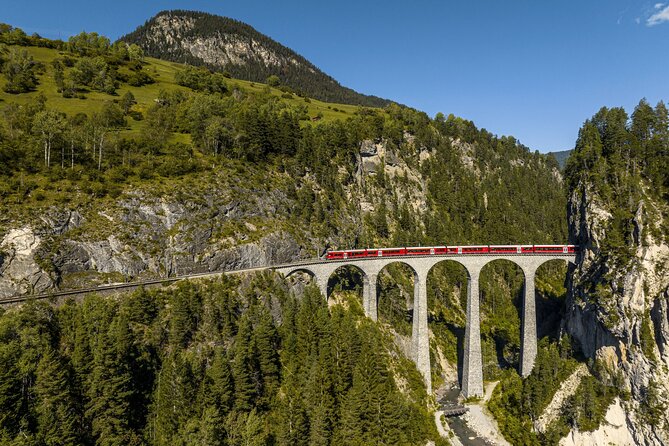
- Landwasser Viaduct views: a standout curved viaduct that you can spot from the train
- Albula Pass to Preda: the route climbs to the highest point on the line before dropping toward St. Moritz
- Bergün in the middle of it all: traditional Swiss architecture and village scenery during the ride
- St. Moritz for about 2 hours: enough time to walk, look, and reset before the return transfer
- English is guaranteed: Spanish support may vary by day, so plan around English
What this day trip really delivers from Milan
This is a “one-day rail show” run by Zani Viaggi that starts in Milan and ends in St. Moritz, with a main train ride through Switzerland’s Albula corridor. The big idea is simple: you spend the center of your day on a famous UNESCO railway famous for viaducts, tunnels, and steep mountain grades, then you get a short break in St. Moritz before heading back.
Now, about the name. The wording Bernina and Glacier can make you think you’ll bounce between two different famous rail routes all day. In reality, the experience is focused on the Albula Line, which is also the first leg of the Glacier Express route. Keep that in mind so your expectations match what you actually ride.
If you want comfort, this trip is set up well for a long day: second class train tickets are included, you travel with a guide, and you have an air-conditioned vehicle for the Milan parts. It is not a slow, leisurely two-week rail trip, though. It is a packed day where the train is the main event.
You can also read our reviews of more tours and experiences in Milan
Milan to the Alps: your guided start matters more than you think
The morning begins with meeting up near public transportation—where exactly can vary depending on the option you booked. From there, you use an air-conditioned vehicle and travel as part of a guided group. That matters because mountain days are sensitive to timing, and the program notes that schedules can shift due to traffic or other organizational needs.
You also get a mobile ticket, and you receive confirmation at booking time. Those small things cut down on stress. For a day trip like this, stress is the enemy. You want your attention on what the windows show, not on where to stand and which paper to pull out.
Because this is a group tour with up to 50 people, you’ll generally get an organized flow: guide, ride, train, and then the town stop. I find that’s the key difference between a good rail day and a chaotic one—someone keeps the gears turning.
The UNESCO Albula Line: Chur to the Albula Pass in motion
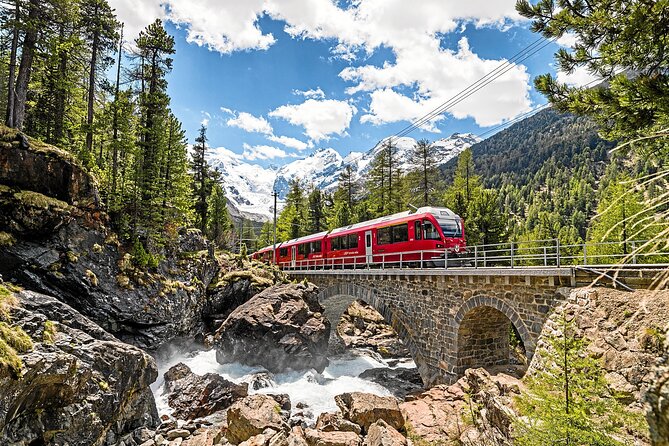
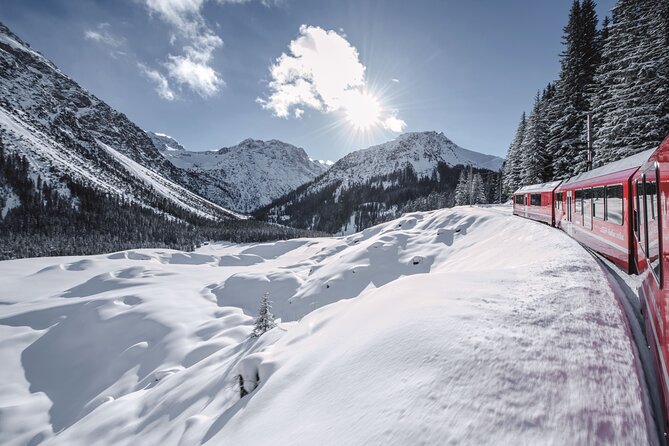
Once the group gets onto the train, you’re on the UNESCO World Heritage Albula Line. This is the type of railway where the engineering is part of the scenery. As the train departs Chur, you head through lush valleys, pass quaint Swiss villages, and track along meandering rivers.
Then the route starts to pull upward. You’ll work your way through the Albula Pass area with panoramic mountain views. You are not just traveling from point A to point B; you’re watching the railway climb and curve through terrain that would be difficult to cross any other way.
What I like about this portion is how the scenery changes in a predictable rhythm. You start with valley views, then you transition into tighter mountain perspectives. You get forests, rock cuts, and those frequent structural moments—viaducts and tunnels—that make the train feel like it’s threading a route through the mountains rather than simply passing through them.
Landwasser Viaduct: the engineering moment you’ll actually remember
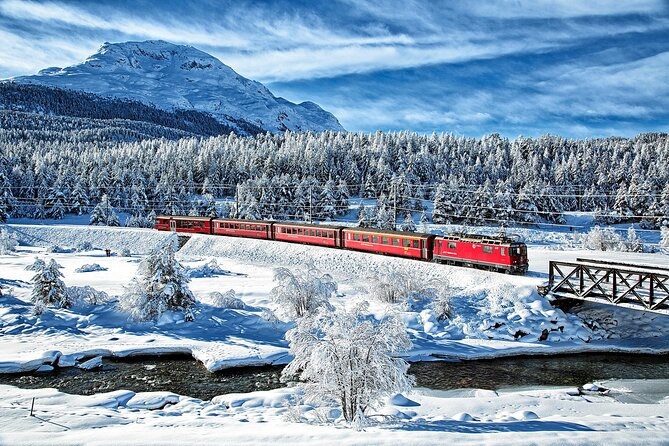
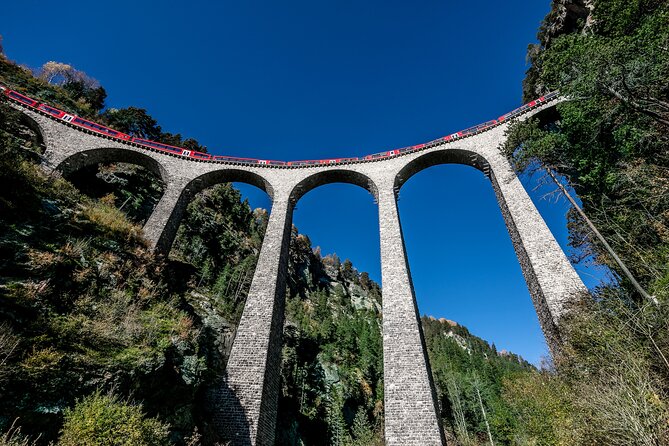
If you only remember one thing from the ride, make it the Landwasser Viaduct. The route includes it for a reason: it spans a deep gorge and uses a distinctive curved design that’s visually dramatic from the train.
This is a great example of why rail tourism works. You do not need to hike a difficult trail or interpret a complicated viewpoint. You just sit on the train and the perspective comes to you. When the viaduct shows up, you’ll quickly understand why this railway is famous for engineering and design.
One practical note: long window moments can be fought over if you’re in a busier group. So if your coach assigns seats or if boarding feels rushed, I’d still try to position yourself early so you get a clear look as these structures roll by.
Tunnels and viaducts: how the ride keeps you focused
The Albula Line is known for numerous viaducts and tunnels, and the rhythm matters. Tunnels briefly shift the mood—cooler air, less direct light—then you pop back out into open view corridors where another structure or valley shows itself.
For a day trip, this is a big win. It keeps the ride from blending together. You get repeated “wait for it” moments, where the outside changes and you feel like you’re watching the route reveal itself in chapters.
Also, the program highlights that the route has multiple technical features. That usually means the train is constantly negotiating the terrain, which is exactly what you want if you’re traveling specifically for rail scenery rather than just transport.
Bergün and Preda: where the vibe shifts before the descent
As you continue, the train passes through Bergün, a charming Swiss village known for traditional architecture and a picturesque Alpine setting. This is one of those stops-through that feels human-scaled compared with the huge rock and gorge sections.
I like Bergün here because it gives the ride variety. You’re not only seeing structures; you’re also seeing a lived-in place—buildings, village scale, and that sense of an old railway community. If you enjoy small towns in travel, you’ll probably notice the change in details around here.
Then comes Preda, the highest point on the line in this route sequence. Reaching Preda adds a clear climax to the day: you go from climbing and panoramic widening views to the moment where the itinerary starts setting you up for the descent.
After Preda, the route heads downward toward St. Moritz. That descent is often when the scenery starts to feel more open and settled again, which is a nice mental shift before you switch from train mode to town mode.
St. Moritz for about 2 hours: what to do with the time
You end the rail portion in St. Moritz, a well-known resort town in the Engadin Valley. The program gives you about 2 hours for a city visit, and no extra paid admission is listed for that stop.
In that short window, I’d focus on the simple things that work in almost any town: a walk to orient yourself, a quick look at what people are actually doing on the streets, and some time to enjoy the lakes-and-peaks backdrop that St. Moritz is known for. If the weather is clear, you’ll get more from the streets and viewpoints. If it is cloudy or chilly, you’ll still get value from a short wander and a warm-up break.
This is also where pacing pays off. After 10+ hours with long windows and switching between tunnel and open view, you’ll probably appreciate not having to pack in museums or long hikes. Two hours is enough time to feel the place without draining the day.
The return to Milan: why the last leg still matters
After your St. Moritz time, you go back by coach to Milan. Transit time is included in the total duration (about 13 hours), so you should plan the day like it is a full outing, not a quick add-on.
Because road timing can shift, keep a little mental buffer. The itinerary notes that times can change due to traffic or organizational requirements to make sure you get the full enjoyment of the tour. In plain terms: you might not be able to control every minute, so don’t build a second plan that depends on arriving in Milan at a specific hour.
Also remember you’re traveling in both directions in one day. This is the kind of trip that feels great when you’re okay with being on a schedule, not so great if you hate guided pacing.
Price and value: what you pay for at $163.53
At $163.53 per person, the value comes from the bundle. You are not just buying a train ticket; you’re getting:
- a guided experience
- air-conditioned vehicle transfers
- a 2nd class train ticket for the rail portion
- the structure of a full day from Milan to St. Moritz and back
Food and drinks are not included, so you’ll want to either plan to buy something on your own during breaks or accept that you’ll be eating separately. Also, hotel pickup and drop-off is not included—this is a meeting-point style trip.
The biggest “value check” is expectation setting. If you want two separate famous rail experiences (as in two distinct express rail journeys), you may feel disappointed because the experience is really centered on the Albula line ride. But if your priority is the UNESCO Albula corridor plus St. Moritz time, then this is a solid way to do it without handling all the logistics yourself.
One more useful detail: this trip tends to sell with enough lead time that it’s commonly booked about 49 days in advance on average. If you have firm travel dates, don’t wait until the last moment.
Who should book this, and who should skip it
This is a good match if you:
- want a major rail scenery day without complicated planning
- enjoy engineering sights like viaducts and tunnels from your seat
- like the idea of a short St. Moritz break without committing to a multi-day stay
- travel in the range where you’re fine with long days and guided timing
You might want to skip (or at least double-check your expectations) if you:
- expected to ride two fully separate named express routes back-to-back
- prefer lots of free time and flexible wandering during the mountain transit itself
- hate weather-dependent rail expectations and want a guaranteed outdoor schedule regardless of conditions
What to pack for Alps weather that changes fast
The program warns that weather in this region can be extremely variable. That’s not a reason to worry; it’s a reason to dress like you’ll see multiple conditions in one day.
Bring layers you can add or remove quickly, because your body temperature will swing from open mountain air to train interiors and then to St. Moritz street weather. Sunglasses help when the light hits snowy peaks. A hat or light gloves can be worth it, especially if you’ll be standing outside for any views around town.
Also think about comfort. Second class is included, but you’ll still be seated for long stretches, so bring what keeps you comfortable for window time rather than what’s best for a short city stroll.
A quick, honest booking decision
If your goal is one iconic UNESCO rail ride in the Swiss Alps plus a stop in St. Moritz, this trip is worth considering. The core strength is the Albula Line experience—viaducts, tunnels, the Albula Pass approach, and the Landwasser Viaduct moment—paired with a manageable 2-hour town window.
If you’re specifically chasing the idea of two distinct famous express rides all day, read the fine print in your booking materials and align your expectations. The title can mislead, and this experience is mainly centered on the Albula/Glacier Express first-leg route to St. Moritz.
FAQ
How long is the tour?
The duration is about 13 hours including travel time.
What does the tour include?
It includes a professional guide, an air-conditioned vehicle, and the Bernina and Glacier train ticket (2nd class). The tour may be bilingual, depending on the reservation.
Is food and drinks included?
No. Food and drinks are not included.
What train route will I ride?
The rail portion follows the Albula Line, which is the first leg of the Glacier Express route, with the ride ascending through the Albula Pass and continuing toward St. Moritz.
Where do we stop during the day?
The major town stop is St. Moritz, after the train ride, with about 2 hours for a city visit.
What language support is available?
English is always guaranteed. Spanish is not guaranteed every day.
Do I get a mobile ticket?
Yes. The tour uses a mobile ticket.
How big is the group?
The tour has a maximum of 50 travelers.
What happens if the weather is bad?
The tour requires good weather. If it is canceled due to poor weather, you’ll be offered a different date or a full refund.
Is free cancellation available?
Yes. You can cancel up to 24 hours in advance for a full refund.